
Egon Schiele, Russian Prisoner of War (“Ivan Ivtinovitch Tarasinko”), DETAIL, , 1916 © Leopold Museum, Vienna
Viennese Stories – The Leopold Museum Blog
Humanity or Hatred
Traces of War
Martial, charged with energy, and brimming with confidence—so a phalanx of soldiers storms forward with expansive strides, their weapons thrust powerfully before them. Like the captivating metaphorical images in "Masse und Macht", the seminal work by Nobel laureate Elias Canetti, which speaks of a "marching forest" of soldiers, the figures here too merge into a menacing unity. Stripped of individuality, their cruel faces are transformed into featureless, smooth masks. Their synchronized movements embody the mechanisms of the first industrialized war of mass destruction in human history.
In contrast to his later oeuvre, where graphic artist and painter Albin Egger-Lienz translated his own harrowing experiences of World War I and its oppressive aftermath into monumental, expressive forms, his almost monochromatic lithograph Forward-Charging Soldiers from 1915 conveys a pathos in favor of war. This ambivalence becomes evident shortly afterward when, in his painting War, Egger-Lienz alters the subject by incorporating fallen soldiers into the composition.
The sculptor Ernst Barlach, based in Rostock, was also initially swept up in the enthusiasm for war. His saber-wielding Avenger strides forward with sharp, angular forms, powerfully slashing through all that dares to obstruct his path, employing the stylistic principles of Cubism and Futurism. Like many others, Barlach hoped for a profound societal transformation, a shift away from suffocating structures toward spiritual renewal. However, he remained an astute observer, deeply reflective of the war's brutal impact. The long coat of his figure is constructed from triangular forms whose edges radiate toward the head, imparting a sense of dynamic forward motion. Yet, in contrast to the aggressive energy of the body, the facial expression conveys thoughtful hesitation.
ALBIN EGGER-LIENZ, Surging Soldiers, 1915 © Leopold Museum, Vienna
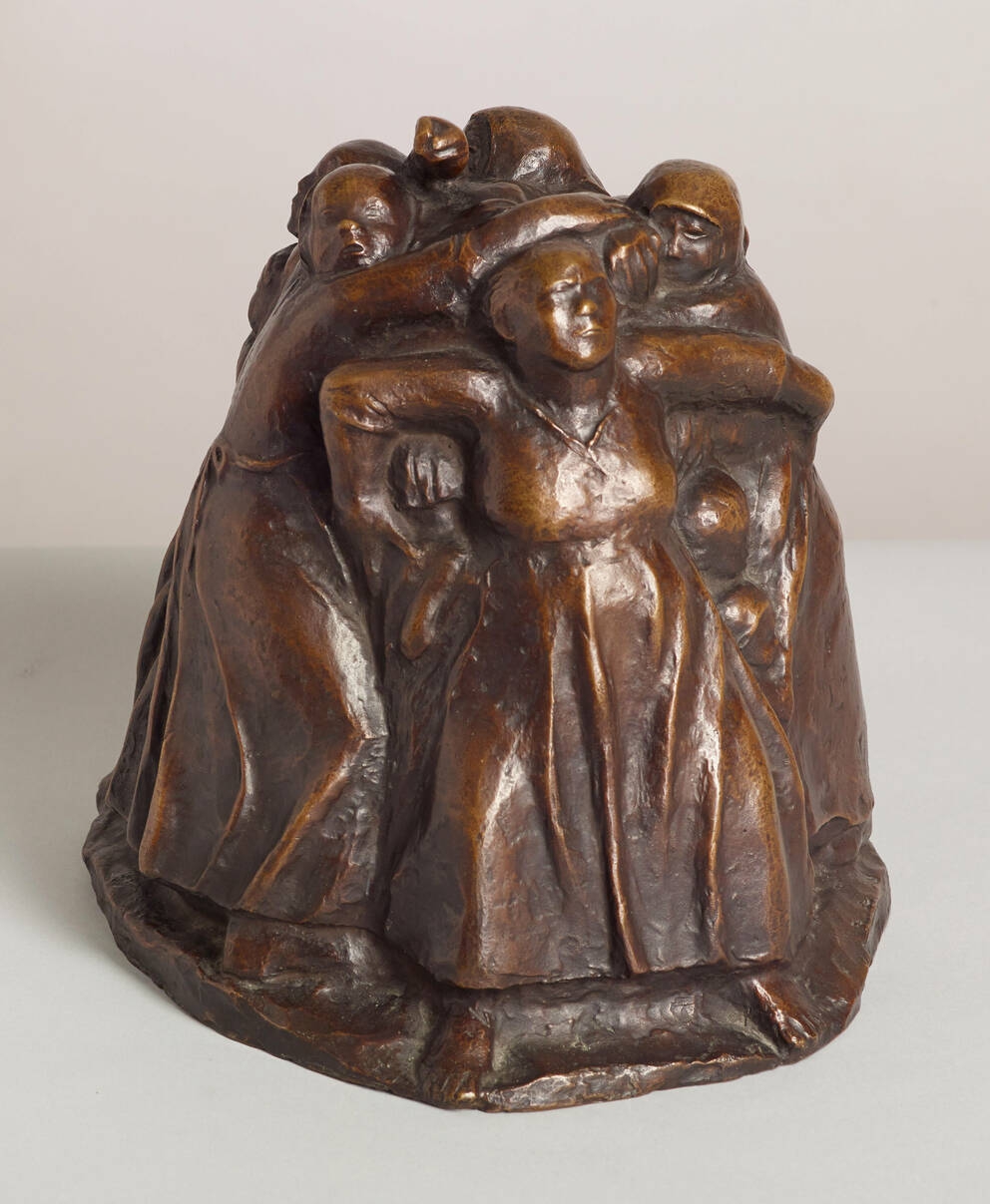
A close friend of Barlach, frequently seeking his artistic advice, the Moritzburg-based draughtswoman and printmaker Käthe Kollwitz ventured into sculptural solutions herself. She made no secret of her pacifist stance. Her personal experience as a mother, who lost her younger son in one of the early battles of World War I in 1914, reverberates throughout her work. Beginning in 1922, her graphic cycle War addresses, with visionary urgency, the looming dangers of another political collapse. In her 1937/38 circular sculpture Tower of Mothers, female figures use their bodies to form a protective barrier around their children, shielding them both from external threats and internal vulnerabilities: Kollwitz’s son Hans had volunteered for frontline service. Tellingly, the bronze sculpture, cast in 1938 based on Kollwitz's designs, was removed by the National Socialists from a Berlin exhibition at the Atelierhaus with the explanation that in the Third Reich, mothers had no need to protect their children, as the state fulfilled that role.
Egon Schiele, Russian Prisoner of War (“Ivan Ivtinovitch Tarasinko”), DETAIL, , 1916 © Leopold Museum, Vienna
Hopeless, disillusioned, and desperate—such is the gaze of Ivan Ivtinovitch Tarasinko. The Russian prisoner of war is led each morning, along with his comrades, to forced labor by a melancholic young man: the painter Egon Schiele. Schiele created numerous portraits of Russian and Italian soldiers during this time at the barracks. Each depicts young, sorrowful individuals who, like Schiele himself, stare blankly into a fractured world marked by cruelty and brutality. On the reverse of one such portrait is the note: "Fallen, 1914." The watercolor painting once again reveals Schiele as a psychologically astute chronicler: he does not portray the enemy but a fellow sufferer, someone who, like himself, has experienced how the fragile ground of humanity has shattered beneath their feet.
Article by Markus Hübl